Research

Technology should meet people where care actually happens.

My work centers the lived experiences of people with epilepsy and their caregivers to understand support needs, evaluate existing tools, and imagine more accessible digital health systems.

A life-course approach to epilepsy and technology

Epilepsy management involves much more than recording seizures. People navigate uncertainty, memory and medication demands, changing independence, clinical communication, social relationships, and care partnerships. I study these experiences across adolescence, adulthood, and later life, drawing on online communities, interviews, app evaluations, and mixed computational-qualitative analysis.

Epilepsy self-managementCaregiver supportAccessible computingOnline health communitiesDigital health
Epilepsy research

Online Support Across the Life Course

Understanding the experiential knowledge people seek and share outside clinical encounters.
Connected nodes representing online support across people and care roles

Research problem

Clinical resources cannot fully answer the day-to-day questions raised by an unpredictable and highly individual condition. Online communities reveal support needs that are otherwise easy to miss.

Populations

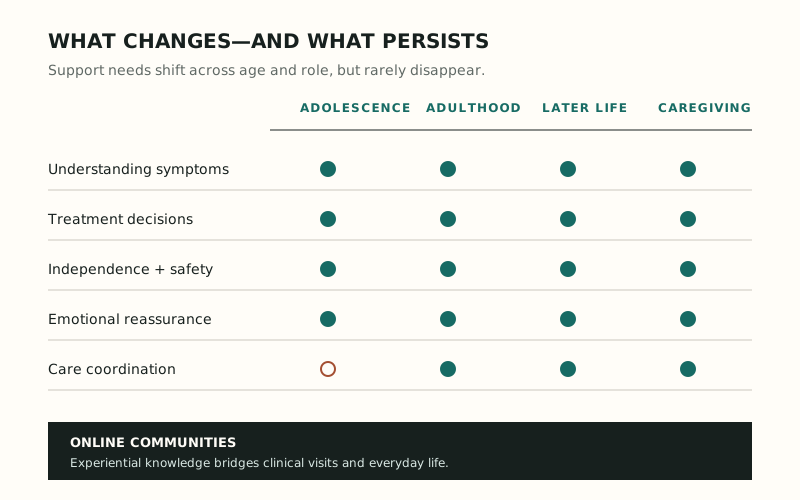
My work examines the experiences of adolescents, adults, older adults with epilepsy, and caregivers—attending to how information needs and agency shift across roles and life stages.

Methods

Topic modeling, thematic analysis, qualitative coding, and psycholinguistic analysis connect community-scale patterns with close interpretation of individual disclosures.

Emerging insights

People seek help with symptoms, treatment, seizure interpretation, independence, emotional support, and care burden. Older adults and caregivers also navigate role-dependent gaps in knowledge and tensions between safety and autonomy.

Scope of current work: 23,945 r/Epilepsy posts in a broad community analysis; 5,396 adolescent-related posts; and a focused qualitative study of 143 posts by older adults and caregivers.
Epilepsy research

Accessible Self-Management Technology

Evaluating apps and self-tracking ecosystems through accessibility, quality, and lived experience.

Layered diagram representing accessibility, quality, and self-management

Research problem

Epilepsy technologies may promise organization and insight while failing to represent diverse seizures, requiring excessive effort, or introducing accessibility barriers.

Technology evaluation

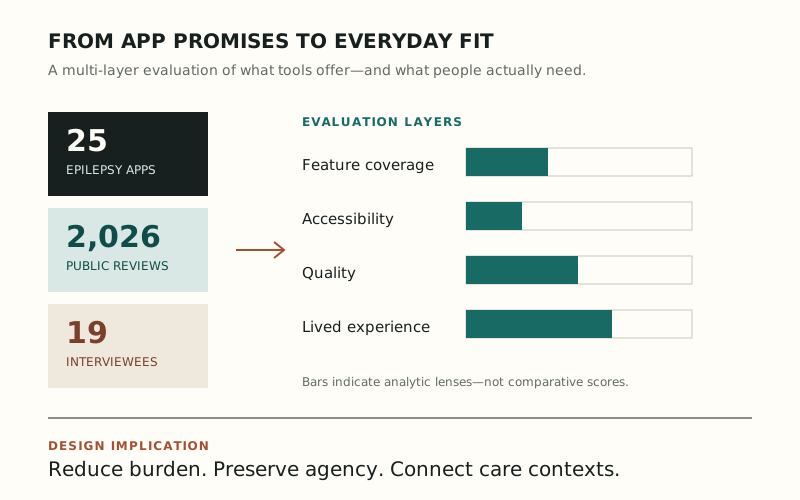
I examine app features against established self-management domains and assess quality and accessibility through automated and manual audits.

Lived experience

Interviews with people living with epilepsy and caregivers explore how journals, apps, portals, reminders, and wearables fit—or fail to fit—everyday life.

Design direction

The findings point toward flexible, interoperable, privacy-conscious systems that support memory and clinical communication while keeping people in control.

Scope of current work: 25 epilepsy apps, 2,026 public app-store reviews, and qualitative interviews with 19 people with epilepsy and caregivers.

Secondary research thread

Responsible AI-Mediated Relationships

Studying how communities and platforms negotiate intimacy, overreliance, safety, and responsibility.

Intersecting paths representing users, communities, AI companions, and platforms

Community response

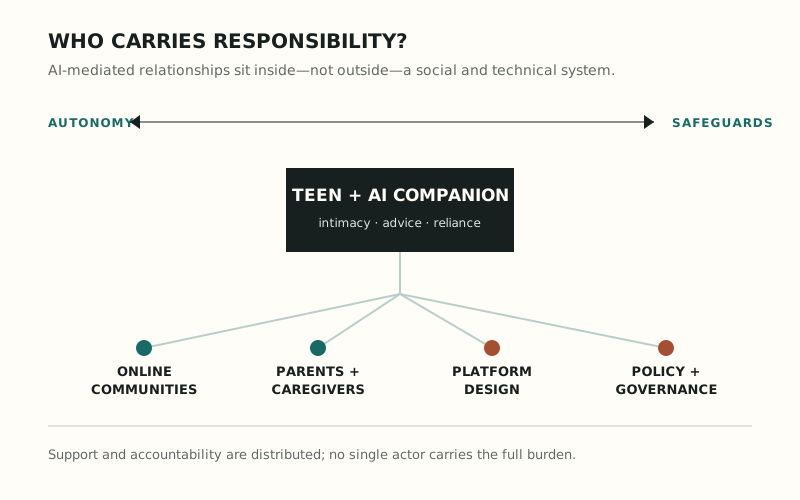
I contribute to research on how online communities respond when adolescents disclose overreliance on AI companion chatbots, including informational and emotional support.

Responsibility

This work examines how commenters distribute responsibility among teens, parents, and platform companies while debating autonomy, safeguards, and benefits.

Platform governance

A related policy analysis studies how companion AI platforms promote intimate relationships while governing emotional and sexual risks through uneven or opaque rules.

Broader connection

Like my health research, this work asks how digital systems can support people without exploiting vulnerability or shifting every burden onto users.

Methods: qualitative content analysis, comment-tree analysis, and comparative platform policy analysis.